
Why First-Year Group Benefits Quotes Can Be Misleading
What small businesses should know about comparing first-year pricing, renewal stability, plan fit, and long-term value.
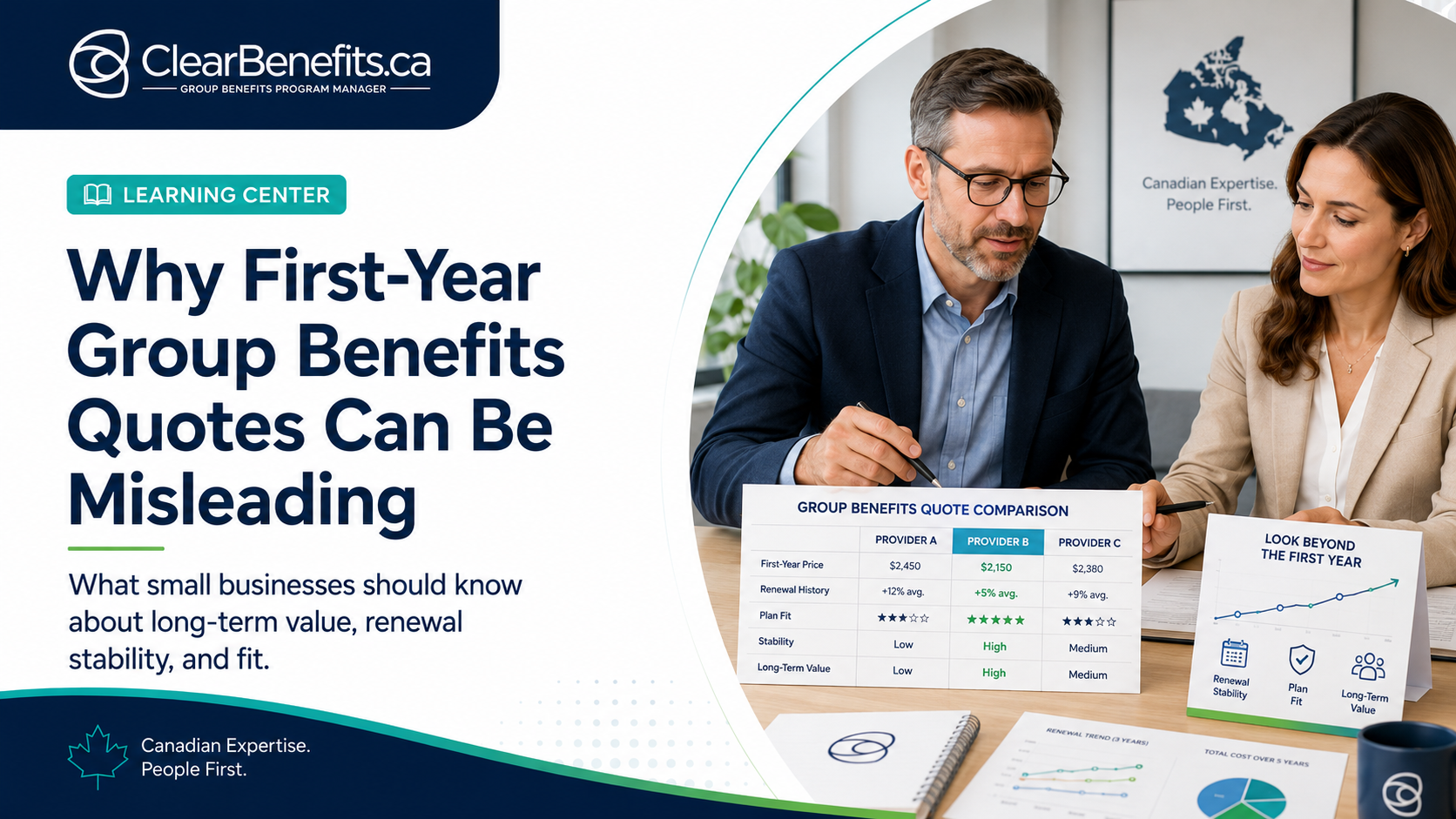
A low first-year group benefits quote can look like the obvious choice.
For a small-business owner, that is understandable. Benefits are a real expense, and controlling cost matters.
But the lowest first-year quote is not always the best long-term decision.
In some cases, a first-year quote can make a plan look more attractive than it will actually be over time.
That is why group benefits should be evaluated on more than price alone.
The problem with focusing only on year one
When a business compares benefits quotes, the first thing many people look at is the monthly premium.
That number is important, but it does not tell the full story.
A first-year quote may not clearly show:
- - how renewals are calculated;
- - how claims volatility may affect future rates;
- - whether the plan design matches the business;
- - whether the benefits are sustainable;
- - what support is available at renewal;
- - how employees will actually use the plan;
- - whether the quote is built for long-term value or only first-year appeal.
A low quote can be helpful. But if it is not connected to a sustainable structure, it can create problems later.
Why renewals matter
Group benefits are not a one-time purchase. They renew every year.
That means the real cost of a plan is not only what it costs today. It is what it may cost next year, the year after, and beyond.
For small businesses, renewal volatility can be especially difficult.
A plan that starts with a low premium but renews sharply can create budget stress. It can also force employers into uncomfortable decisions, such as reducing coverage, increasing employee cost-sharing, changing providers, or cancelling the plan.
That is why renewal stability should be part of the buying decision from the beginning.
Plan fit matters as much as price
The right benefits path depends on the business.
A self-employed professional, a two-person incorporated business, a seven-life trades company, and a 24-life professional office may all need very different structures.
That is why ClearBenefits.ca uses a fit-first approach.
Rather than starting only with price, we look at the business situation and help identify the most appropriate path:
ClearOne for 1–2+ lives and non-traditional fits.
ClearGroup for traditional small businesses with 3–20+ lives.
Custom 20+ for larger or more complex groups.
The goal is to avoid forcing the wrong structure onto the wrong business.
What a better quote comparison should include
When comparing group benefits options, employers and advisors should look beyond first-year cost.
A better comparison includes:
| Question | Why it matters |
|---|---|
| What is the first-year premium? | Affordability still matters. |
| What is the renewal history? | Helps assess long-term stability. |
| How is the plan funded or pooled? | Affects future volatility. |
| Does the plan fit the workforce? | Avoids mismatched coverage. |
| What support is available? | Matters during onboarding, service, and renewal. |
| Is the plan sustainable? | Helps protect the employer and employees over time. |
The strongest quote is not always the lowest quote.
The strongest quote is the one connected to the right structure.
ClearGroup: designed to perform over time
ClearGroup is built around the idea that small businesses need more than a first-year price.
They need a plan designed for long-term stability.
That is why ClearGroup emphasizes pooled purchasing power, predictable renewals, and long-term renewal results.
ClearGroup’s renewal history includes:
19-year average renewal: 5.98%
2026 renewal: 2.93%
Those numbers help shift the conversation from “What is cheapest today?” to “What is most sustainable over time?”
The advisor’s role
A good advisor helps the client understand more than the quote.
They help explain:
- - what the numbers mean;
- - what risks may exist;
- - how the plan may renew;
- - whether the structure fits the business;
- - how the employer can manage the plan over time.
ClearBenefits.ca supports advisors with program options, resources, fit assessment, quoting support where appropriate, onboarding, service, and renewal support.
That advisor-supported model is important because small businesses often need guidance, not just a price.
Final thought
A first-year quote is a starting point, not the whole decision.
Before choosing a group benefits plan, small businesses should ask:
Will this plan still make sense at renewal?
That question can help prevent short-term decisions from becoming long-term problems.
Before choosing based on price alone, talk to a ClearBenefits.ca advisor about plan fit, renewal stability, and long-term value.
Want a solution based on what you need?
Use Find your best-fit path to identify the right structure first — it does not replace advisor guidance or quoting.